Waterfront
In short: Building or replacing a pontoon on a Gold Coast canal or other tidal water needs operational works approval for tidal works from the City of Gold Coast before work starts, with the Gold Coast Waterways Authority (GCWA) as referral agency. The design must meet Queensland's prescribed tidal works code, with drawings and final certification by a Registered Professional Engineer of Queensland (RPEQ).
Key takeaways
- The City of Gold Coast requires operational works approval for tidal works, such as pontoons and jetties, before construction begins.
- GCWA is the referral agency for Gold Coast tidal works applications and recommends contacting it before you lodge.
- Queensland's code requires pontoon loads to be designed to AS/NZS 1170 and AS 1170.4, AS 3962 and AS 4997, and certified by an RPEQ.
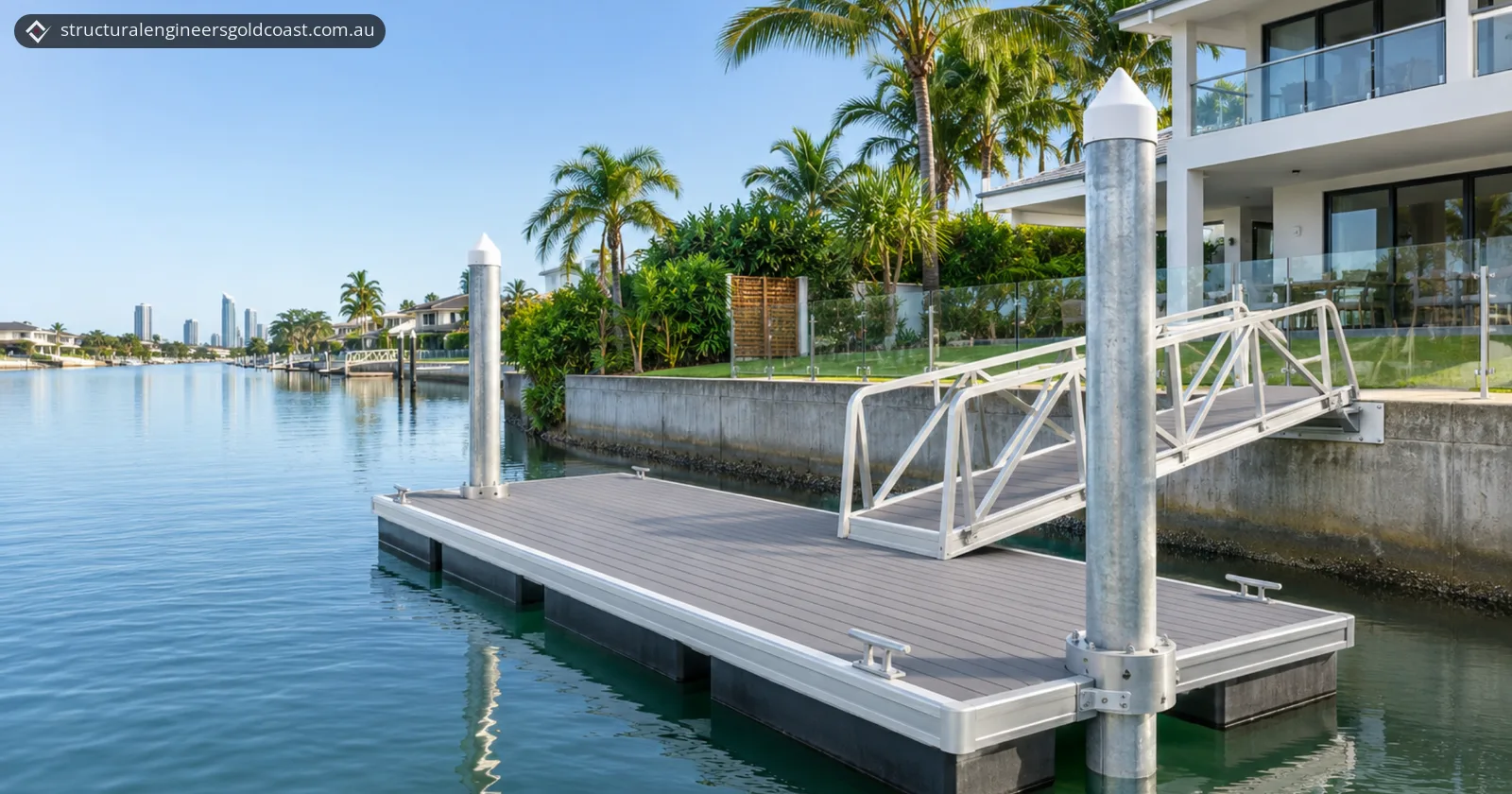
- A pontoon must rise and fall with the tide, including flood and storm tide, while staying moored by piles or bank anchors.
- Even a second-hand pontoon needs tidal works approval and an engineering certificate confirming it is structurally sound, the City says.
Planning a new or replacement pontoon or jetty? Get a quote or call 07 5638 5491.
Do you need approval to build a pontoon on the Gold Coast?
Yes. A pontoon on a Gold Coast canal or other tidal water needs operational works development approval for tidal works before construction begins (City of Gold Coast). The City lists the construction or demolition of jetties, pontoons, revetment walls and boat ramps among tidal works.
Tidal works are defined in the Coastal Protection and Management Act 1995. "Prescribed tidal works", defined in the Coastal Protection and Management Regulation 2017, include all tidal works except a short list, such as works in a State managed boat harbour or for a port operator. Local government assesses those works against the Code for assessable development that is prescribed tidal works, in Schedule 3 of that Regulation (Queensland Government guideline).
The City of Gold Coast also says:
- pontoons and jetties are only allowed where a property has a sufficient waterway allocation area, which depends on the side boundary angles, the length of the water frontage and nearby approved structures;
- a property that can't have a pontoon or jetty may be able to have a boat ramp;
- the maximum vessel size is set in the approval or the approved plans;
- installing a second-hand pontoon still needs tidal works approval, plus an engineering certificate confirming it is structurally sound.
Who approves a pontoon on a Gold Coast canal?
The City of Gold Coast is the assessment manager for most tidal works, and the Gold Coast Waterways Authority (GCWA) is the referral agency (GCWA). GCWA checks navigation and waterway management. The City assesses amenity, community impact, waterway character and engineering. GCWA recommends contacting it before you lodge.
The approval path changes with the type of water the property fronts:
| Where the pontoon goes | Who assesses | Extra consent the City or GCWA mentions |
|---|---|---|
| Tidal canal | City of Gold Coast, with GCWA as referral agency | None listed for the canal itself |
| Natural tidal waterway (not a canal) | City of Gold Coast, with GCWA as referral agency | Consent from the owner of the waterway, typically the State |
| Non-tidal water on council land (e.g. Monterey Keys, behind lock and weir structures) | City of Gold Coast non-tidal works application | A lease and letter of consent from the City's Property Services |
| Sanctuary Cove Resort, facing the Coomera River | City of Gold Coast and the State, lodged with the City | The State decides under section 104 of the Sanctuary Cove Resort Act 1985 |
Sources: City of Gold Coast, coastal works; City of Gold Coast, non-tidal works. The City says a non-tidal works application has no status under the Planning Act 2016.
Where works affect State interests, the State Assessment and Referral Agency (SARA) assesses them against State Code 8: Coastal development and tidal works (Queensland Government).
How far out and how wide can a Gold Coast pontoon be?
A Gold Coast pontoon can generally extend to the quay line, which varies between waterways (City of Gold Coast), and stays in front of its own property. GCWA's Tidal Works Mapping shows quay lines, vessel allowances and fairway widths.
The State guideline explains that the code only permits structures in front of the owner's property, inside its side boundaries extended over the water. Works are set back 1.5 m from the extended side boundary, so there is always a 3 m wide access corridor between properties. GCWA's Tidal Works Factsheet adds:
- T-head or parallel pontoons: 1.5 m minimum clearance to the extended side boundaries, for the structure and any vessel up to 15 m long. For a longer vessel, the spacing between berthed vessels must reach 0.2 × the vessel's length overall, so a 17 m vessel needs 3.4 m.
- Narrow lots: GCWA can't accept T-head pontoons on corner, cul-de-sac or narrow lots with less than 8 m at the quay line; a finger pontoon may suit instead, with at least 1 m from the vessel to the extended side boundary.
- Turning: the vessel must be able to turn in front of the property within 1.5 × its length overall, and leave the waterway bow first.
GCWA's Development Assessment Code notes that many Gold Coast canals lack a bulbous end for turning. It also says GCWA won't treat existing approved structures that don't meet current requirements as a precedent, which matters when you replace an old pontoon.
What design loads and standards apply to a pontoon or jetty?
Under Schedule 3 of the Coastal Protection and Management Regulation 2017, a pontoon must carry its intended loads in line with AS/NZS 1170.0, 1170.1 and 1170.2, AS 1170.4, AS 3962 (marinas) and AS 4997 (maritime structures). The Regulation's definitions cite the 2001 edition of AS 3962, while GCWA applies AS 3962-2020.
Every prescribed tidal work must also be structurally sound having regard to flooding, storm tide, wave overtopping, projected sea level rise, tides, hydrodynamic forces, design life and hydrostatic pressure. Materials must resist marine organisms, corrosion, abrasion, immersion in seawater and wave action.
| Code item | Private pontoon (not in a marina) | Private jetty |
|---|---|---|
| Loading standards | AS/NZS 1170.0, 1170.1, 1170.2, AS 1170.4, AS 3962, AS 4997 | AS/NZS 1170.0, 1170.1, 1170.2, AS 1170.4, AS 4997 |
| Stability or level | Top of the flotation unit stays above water with 1.5 kPa on half the unit and the whole walkway; base stays in the water and tilts no more than 15° | Deck at least 300 mm above highest astronomical tide, or piles or markers show where it is |
| Access | Walkway extends at least 500 mm onto the flotation unit | On State tidal land, deck 900 mm to 3 m wide and inside the water allocation area |
| Tide and flood | Rises and falls with tide, flood and storm tide; moored by piles or bank anchors; tethered if a 1% annual exceedance probability (AEP) flood or storm tide would detach it | Not stated as a separate item |
How are pontoon piles and the canal wall checked?
A pontoon must be moored by piles or by its mooring system attached to concrete anchors in the bank, so it rises and falls with the tide without separating from the lot (Regulation, Schedule 3). The code defines a pontoon as a flotation unit, an access walkway, a mooring system (for example piles or anchored cables) and an abutment for the walkway.
The engineer also has to consider the existing bank. Piling, abutments and other parts of the works must either place no additional load on an existing revetment, seawall or other structure, or be capable of being supported by it. The works must not disturb the bed and banks by changing water flow, or affect water quality through exposure to acid sulphate soils.
GCWA asks for scaled side or elevation drawings showing the structure, the vessel and the seabed profile; the City's Development Assessment team can supply canal profiles. In rivers and large creeks with high flood flows, the State guideline recommends a liner at least 6 mm thick around the expanded polystyrene in the floats, because large numbers of pontoons in South East Queensland have been significantly damaged during floods; the guideline notes the release of polystyrene was particularly evident after the 2022 floods. It says canals may not need that liner design.
What does RPEQ certification involve for a pontoon?
RPEQ certification means a Registered Professional Engineer of Queensland signs the design, then certifies the built work. The City of Gold Coast requires RPEQ-certified drawings with the application: a locality plan, site plan, notes, elevation, structural details and foundation details. It also requires final certification from an RPEQ once construction is complete.
The code accepts certification from an engineer registered in civil, environmental, geotechnical or structural engineering. The State guideline says that engineer should be experienced in the design, construction and safety requirements of tidal structures.
When to call a structural engineer
Call a structural engineer before you order a pontoon or jetty, and when:
- you are replacing an old pontoon and the layout, vessel or piles will change;
- you plan to fit a second-hand pontoon, which needs an engineering certificate;
- the gangway abutment or piles would bear on, or sit near, your revetment wall;
- your frontage is short, curved or at the end of a canal;
- the City or GCWA asks for more information on loads, piles or the seabed profile.
Our structural engineering design service prepares signed structural documentation for certifier or council approval. If the canal wall itself is leaning, bulging or eroding, our structural inspections include stability assessments of existing retaining walls. To get a quote, send the property's lot and plan number, the pontoon supplier's drawings and the vessel's length and beam.
Frequently asked questions
Can the pontoon builder lodge the tidal works application for me?
Generally, yes. GCWA's tidal works factsheet says the manufacturer or supplier of the pontoon, jetty or boat ramp can generally make the tidal works application on your behalf. The application still has to include the property's current registered plan, showing the lot and the owner's name, and the length and beam of the vessel to be berthed.
Who has to maintain a private pontoon on a Gold Coast canal?
The property owner. The City of Gold Coast says waterfront owners must maintain private structures such as pontoons, jetties and boat ramps, and asks owners to remove dilapidated and non-functional ones because they are not safe. Not doing so could lead to enforcement action.
Can I build a bigger pontoon to use as an entertaining deck?
Generally not. The Queensland Government's guideline on the prescribed tidal works code says a private pontoon must not be larger than needed for mooring vessels, or designed for other purposes such as an entertainment deck, and the code limits structure sizes, including roofs.
Does a pontoon need to show which property it belongs to?
Yes. Under the prescribed tidal works code, a label identifying the lot the pontoon is connected to must be written or stamped on, or fixed to, the outside of the pontoon's flotation unit.
Sources
- City of Gold Coast: Coastal development works
- City of Gold Coast: Non-tidal development works
- City of Gold Coast: Living on our waterways
- Gold Coast Waterways Authority: Tidal works
- Gold Coast Waterways Authority: Tidal Works Factsheet (V3.1, July 2023)
- Gold Coast Waterways Authority: Development Assessment Code (July 2025)
- Queensland Government: Tidal works and prescribed tidal works
- Queensland Government guideline: Purpose and use of the Code for assessable development that is prescribed tidal works
- Queensland Legislation: Coastal Protection and Management Regulation 2017, Schedule 3