Foundations
In short: Screw piles are steel piles with a helix plate welded to the base of a hollow steel shaft. An excavator-mounted drive screws each pile down until the helix reaches soil that can carry the load. They can suit Gold Coast sites where firm ground lies too deep for an ordinary footing, and the National Construction Code accepts piled footings designed and installed to AS 2159.
Key takeaways
- Under NCC 2022 Volume Two, which still applies in Queensland, piled footings meet the structural requirement when designed and installed to AS 2159.
- A 2007 Australian paper warns that installation torque alone is a weak capacity check in layered soil, and that site investigation should set founding levels.
- Queensland Government: coastal areas below 5 m AHD likely have acid sulfate soils, which, when disturbed, release acid that can attack steel and concrete.
- Soil-embedded steel structures are commonly designed for 1 mm of corrosion loss, but the engineer should set the allowance from local soil corrosivity.
- The depth of good bearing soil determines both the footing design and the cost of building it, so screw pile costs vary by site.
Building, raising or extending on Gold Coast ground that needs piles? Get a quote or call 07 5638 5491.
What are screw piles?
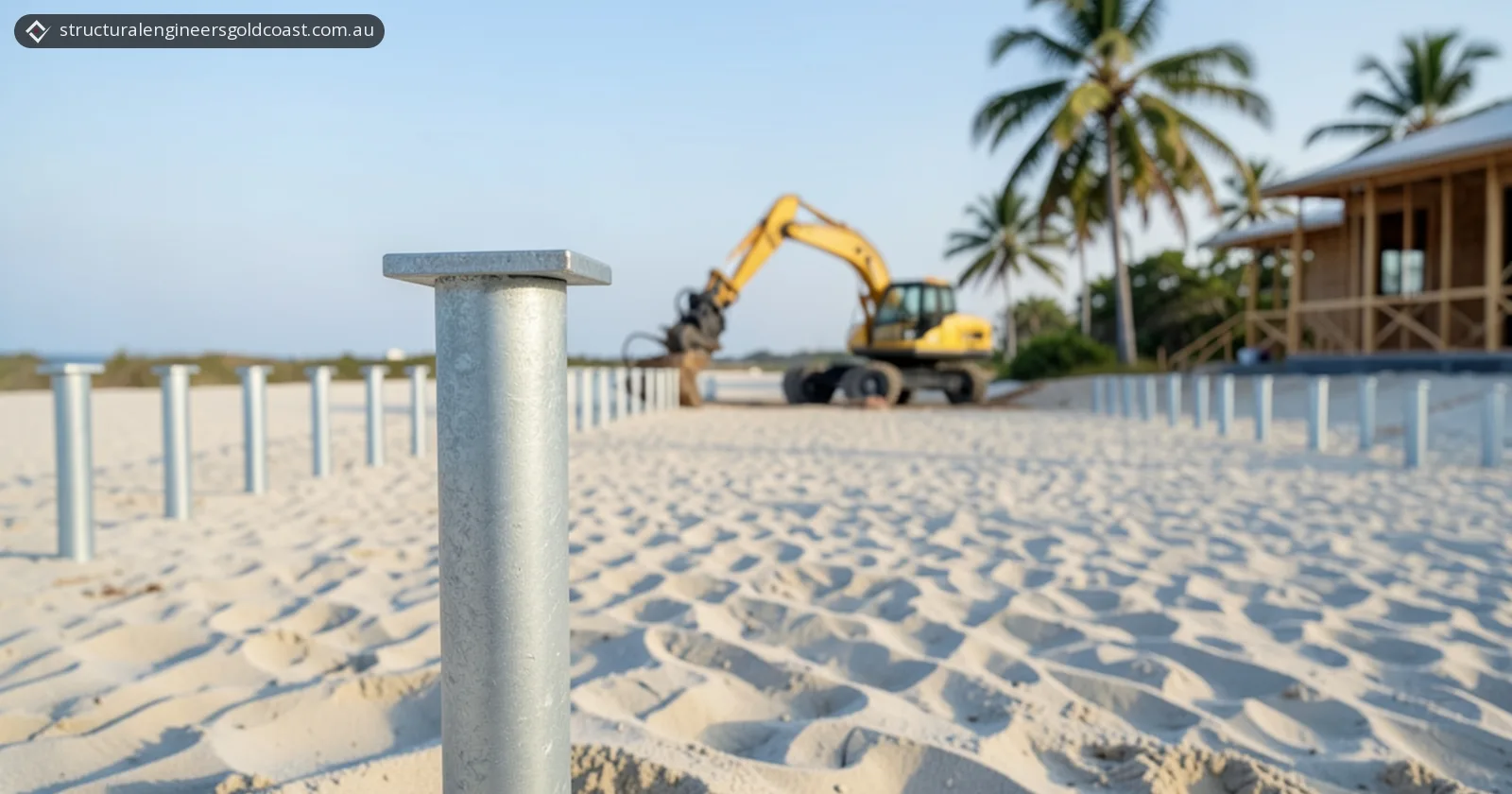
Screw piles are steel piles screwed into the ground until a helix plate at their base reaches soil that can carry the load. A 2007 paper by Bruce McPherson, given at an Australia New Zealand geomechanics conference in Brisbane, describes the common type as a large helical plate welded to the base of a circular hollow section (CHS) steel shaft (McPherson). His typical heavy-duty pile has a shaft 130 to 220 mm in diameter and a helix 400 to 700 mm across. A planetary drive motor on a hydraulic excavator turns the pile, with some downthrust.
The Standard is AS 2159-2009 Piling – Design and installation. Standards Australia says it sets minimum requirements for the design, construction and testing of piled footings; its contents include steel screw piles and installation by screwing.
Where do screw piles suit Gold Coast sites?
Screw piles can suit sites where soil able to carry a building lies too deep for an ordinary footing, but the whole soil profile decides whether they work. RMIT University's building-course notes (Victoria) say pier and beam footings are usually considered when good bearing soil isn't within 1.5 m of the surface (RMIT), and describe power-driven galvanised steel screw piles as an alternative pier system to timber piles.
| Ground | What the sources say |
|---|---|
| Sand | The National Construction Code (NCC) Housing Provisions class most sand sites as Class A, but list loose sands under Class P. McPherson's NSW case-study piles were founded in medium dense to very dense sand. |
| Soft clay or estuarine mud | Class P includes soft clay or silt. The Queensland Government says many acid sulfate soils are estuarine muds and clays with low load-bearing capacity. McPherson reports capacity shortfalls where piles were founded on thin sand layers over soft to firm clay. |
| Steep hinterland slopes | The City of Gold Coast says landslides can occur in steep or unstable areas, especially in hinterland locations. McPherson lists landslide stabilisation among the uses of steel screw piles. |
| Tight or built-up sites | Installation is fast, quiet and low in vibration, with no spoil to dispose of (Western Australian and UK university papers), but needs excavator access. |
How are screw piles installed and load-checked?
Screw piles are screwed in while the installer records the torque, but McPherson says founding levels should rest on a site investigation, not on torque alone:
- Torque. Correlations of about ten times the installation torque (in kN·m) are commonly used to estimate a pile's ultimate geotechnical strength. McPherson says they aren't valid unless the soil profile is completely uniform, which he calls rare in the layered soils of Australia's coastal development centres. Torque also reflects only the soil the helix has passed through, not weaker material below.
- Site investigation. A comprehensive investigation, preferably by cone penetration testing (CPT), should set founding levels.
- The helix. Helix thickness is the most critical dimension, because the plate's strength limits the base resistance the pile can mobilise.
AS 2159 covers construction monitoring and installation torque for screwed piles, and its testing section includes static, high-strain dynamic, bi-directional, rapid load and integrity testing.
How do screw piles hold up to corrosion in coastal ground?
A screw pile's life in the ground depends on the soil's corrosivity, the zinc coating and any extra steel the design allows to corrode. AS 2159's durability section covers exposure classification, corrosion allowance, coatings and cathodic protection for steel piles, and has a clause on acid sulfate soils.
The Galvanizers Association of Australia (GAA) says:
- Hot-dip galvanising usually performs well in soil free-draining enough to stay below 20% moisture, with typical zinc losses of 2 to 6 µm a year, then steel losses of 10 to 20 µm a year once the coating is used up.
- Structures in soil are commonly designed for 1 mm of steel corrosion loss, but the engineer should set the allowance from the local soil's corrosivity.
- The soil–air interface risks accelerated corrosion. For partly buried steel, designers should consider extra protection for the first 250 mm below and above the surface; an extra coating is recommended where steel crosses a soil/groundwater interface.
The Queensland Government says coastal areas lower than 5 m AHD (Australian Height Datum) are likely to have acid sulfate soils, which can also lie buried below 20 m AHD (explained). Dug up or drained, they produce sulfuric acid, which can attack concrete and steel and slowly destroy building foundations (impacts).
Screw piles or bored piers: which suits your site?
Neither suits every site: a screw pile is a steel pile screwed in without spoil, while a bored pier is a reinforced concrete pier cast in a drilled hole, and both must reach good bearing soil.
| Screw piles | Bored piers | |
|---|---|---|
| Installation | Screwed in by an excavator-mounted drive, no spoil (McPherson; Cerfontaine et al.) | Usually 450 or 600 mm in diameter, drilled by a rig that can reach 3 m with minimal disturbance to adjoining structures (RMIT) |
| Bearing | The soil under the helix behaves much like the soil under a bored pile (McPherson) | Founded on good bearing soil at the appropriate depth (RMIT) |
| Check | Torque, which shouldn't be the only check (McPherson) | For a new house, a mandatory inspection before the footing concrete is poured (Business Queensland) |
| Durability risk | Steel corrosion (GAA); acid from disturbed acid sulfate soils can attack steel (Queensland Government) | Acid from disturbed acid sulfate soils can attack concrete (Queensland Government) |
What affects the cost of screw piles?
The cost of screw piles varies from site to site, because it depends on the ground and the design.
| Cost driver | Why it matters |
|---|---|
| Depth to good bearing soil | RMIT's notes say it determines both the structural footing design and the cost of the footing construction |
| Site investigation and load testing | Set founding levels and confirm capacity (McPherson, AS 2159) |
| Helix thickness | Governs the capacity a pile can mobilise (McPherson) |
| Corrosion protection | Extra steel allowance or coatings (GAA) |
| Acid sulfate soils | Construction can be difficult to manage even when the soil isn't acidified (Queensland Government) |
| Machine access | The drive is excavator-mounted (McPherson) |
What rules apply to screw piles in Queensland?
In Queensland, the main rules for screw piles under a house are NCC 2022, the inspection stages in the Building Regulation 2021 and Queensland Building and Construction Commission (QBCC) licensing.
- NCC edition. NCC 2022 continues to apply in Queensland, which has delayed NCC 2025 until 1 May 2027 (Business Queensland).
- Piled footings. Under clause H1D12 of NCC 2022 Volume Two, Performance Requirement H1P1 is satisfied for piled footings designed and installed in accordance with AS 2159.
- Problem sites. The NCC Housing Provisions say that for a site classified H, E or P, reference must be made to AS 2870 for design and construction.
- Inspections. For a new house (a single detached class 1a building), the Building Regulation 2021 requires an inspection after excavation of foundation material and before the footing or slab concrete is poured. For class 10 buildings and structures other than pools, only the final stage is mandatory, though a building approval may list more (Business Queensland).
- Licensing. The QBCC's Foundation work (piling and anchors) licence lists driven, cast-in, groutcrete, compressed and bored cast-in-place piles. Screw piles aren't named, so ask your installer which licence covers their work.
- Landslide areas. For a property in a mapped landslide-susceptible area, the City of Gold Coast says you can engage a Registered Professional Engineer of Queensland (RPEQ) to assess site-specific risk.
When to call a structural engineer
Call a structural engineer before you price screw piles, and when:
- the soil report gives Class P, H or E, or describes soft clay, loose sand or fill;
- the block is steep or mapped as landslide-susceptible;
- the site is low-lying coastal land where acid sulfate soils are possible;
- a deck, extension or new building will sit on piles;
- your certifier asks for pile design, installation records or load test results.
Our structural engineering design service covers footing and foundation design matched to the site's soil classification. During the build, our structural inspections include milestone inspections to confirm the work matches the design. To get a quote, send the soil report, your plans and photos of the site and its access.
Example from our projects
Our pool and deck structural design in Ormeau shows the concrete pier option. The deck's steel stumps sit on 450 mm concrete piers that must extend into stiff natural soil or rock with an allowable bearing capacity of at least 150 kPa, and the drawings ask the contractor to contact the engineer if groundwater is found at the design depth.
Frequently asked questions
Can screw piles be used to underpin an existing house?
They can. McPherson's 2007 paper lists underpinning among the applications of steel screw piles. In Queensland, constructing underpinning is within the scope of the Queensland Building and Construction Commission's (QBCC) Foundation work (piling and anchors) licence class.
Can screw piles resist uplift, for example under a deck or shed?
Yes. A 2022 conference paper by UK university researchers says screw piles are particularly used for their uplift (tension) capacity, which the helix provides by acting like an embedded plate anchor. AS 2159 covers the design of piles in uplift as well as compression.
How deep do screw piles go?
As deep as the soil profile requires. In the NSW case studies in McPherson's paper, screw piles for three- to five-storey residential buildings were founded at about 5.5 to 9 m. Those were multi-storey buildings, so a house may need a different depth.
Sources
- ABCB: NCC 2022 Volume Two, Part H1 Structure (H1D12 Piled footings)
- ABCB: NCC 2022 Housing Provisions, Part 4.2 Footings, slabs and associated elements
- Standards Australia: AS 2159-2009 Piling - Design and installation
- Business Queensland: Delayed adoption of the National Construction Code 2025 in Queensland
- Business Queensland: Stages of a building inspection
- QBCC: Foundation work (piling and anchors) licence
- Queensland Government: Acid sulfate soils explained
- Queensland Government: Impacts of acid sulfate soils
- City of Gold Coast: Landslide hazards
- McPherson (2007): Compression capacity of steel screw piles, 10th Australia New Zealand Conference on Geomechanics, Brisbane (ISSMGE library)
- Cerfontaine et al. (2022): Overflighting screw piles in sand, a detrimental effect? 20th ICSMGE, Sydney (ISSMGE library)
- Bittar et al. (2022): Field investigation to evaluate the uplift capacity and installation performance of screw piles in sand, 20th ICSMGE, Sydney (ISSMGE library)
- Galvanizers Association of Australia: Galvanized steel embedded in soil
- RMIT University Learning Lab: Pier and beam footings
- RMIT University Learning Lab: Bored pier and beam
- RMIT University Learning Lab: Power driven steel screw in columns