Wind loads
In short: A wind rating, or wind classification, is a house site's class under AS 4055 Wind loads for housing. Sites in wind Regions A and B get non-cyclonic classes, N1 to N6; cyclonic Regions C and D get C1 to C4. Ultimate design gust speeds run from 34 m/s for N1 to 86 m/s for N6 and C4. The Gold Coast is in Region B, so homes get N classes.
Key takeaways
- AS 4055 sets 10 wind classes: N1 to N6 for wind Regions A and B, and C1 to C4 for cyclonic Regions C and D.
- The City of Gold Coast is in wind Region B. The 2021 edition of AS/NZS 1170.2 names South East Queensland's part Region B1.
- In Region B, terrain, shielding and topography can move a house from N2 on a sheltered, flat suburban block to N6 on an exposed hilltop.
- Above N3, the NCC Housing Provisions' simplified details for masonry, metal and tile roofs, steel members and window installation no longer apply.
- In Queensland, a house outside AS 4055's limits needs its wind pressures worked out under AS/NZS 1170.2 by an RPEQ, the QBCC says.
Building, extending or re-roofing on the Gold Coast? Send us your plans for a fixed-price quote, or call 07 5638 5491.
What is a wind rating?
A wind rating, or wind classification, is the class that AS 4055 Wind loads for housing gives a house site: N1 to N6, or C1 to C4. Fielders' wind classification design guide describes each class as a combination of wind region, terrain category, shielding and topography, and says the approach suits houses up to two storeys, no wider than 16 m and no higher than 8.5 m. The National Construction Code (NCC) lets the wind actions on a house be worked out with AS 4055 or with the general wind standard, AS/NZS 1170.2 (NCC 2022 Housing Provisions, Part 2.2).
Houses in wind Regions A and B designed with AS 4055 get N classes, which are based on low internal pressures, according to a 2022 paper by John Ginger of the Cyclone Testing Station at James Cook University and John Holmes (Ginger and Holmes).
What design wind speed does each wind class mean?
Each wind class stands for a design gust wind speed, from 34 m/s for N1 to 86 m/s for N6 and C4 at the ultimate limit state. Each class also has a lower serviceability speed: window testing to AS 2047, for example, measures deflection at the serviceability load (Australian Glass and Window Association). The speeds below are from the Fielders guide, which lists AS 4055:2021 as its reference, with km/h converted at 1 m/s = 3.6 km/h.
| Wind class | Serviceability speed (m/s) | Ultimate speed (m/s) | Ultimate speed (about km/h) |
|---|---|---|---|
| N1 | 26 | 34 | 122 |
| N2 | 26 | 40 | 144 |
| N3 | 32 | 50 | 180 |
| N4 | 39 | 61 | 220 |
| N5 | 47 | 74 | 266 |
| N6 | 55 | 86 | 310 |
| C1 | 32 | 50 | 180 |
| C2 | 39 | 61 | 220 |
| C3 | 47 | 74 | 266 |
| C4 | 55 | 86 | 310 |
C1 to C4 share their speeds with N3 to N6, and the difference is internal pressure. Ginger and Holmes explain that a cyclonic classification uses the higher internal pressures that apply to buildings with openings. Such an opening is usually created when wind-borne debris breaks a door or window on the windward side.
Which wind region is the Gold Coast in?
The Gold Coast is in wind Region B, the intermediate region, which generally borders cyclonic Region C. A 2023 paper whose authors include the City of Gold Coast, Geoscience Australia and the Cyclone Testing Station maps Queensland's wind regions after AS/NZS 1170.2 (2011). It lists the City of Gold Coast in Region B, with Brisbane, the Sunshine Coast and the Fraser Coast, and says Queensland's coastal areas south of latitude 25° are defined as Region B (Sexton et al., AJEM 2023).
The 2021 edition of AS/NZS 1170.2 split Region B in two. Ginger and Holmes describe Region B1 as South East Queensland, dominated by thunderstorms and extended west to 200 km, and Region B2 as the tropical cyclone part. The NCC's wind region map, Figure 2.2.3 of the Housing Provisions, shows Region B along the coast around Brisbane.
Are Gold Coast houses cyclone rated?
Gold Coast houses get N classes, not the cyclonic C classes, but Region B design allows for weakened tropical cyclones. Sexton et al. say properties in Region B must be designed to resist weakened tropical cyclones. They note that South East Queensland's homes are not designed for the high internal pressure from a failed door or broken window, which can significantly increase loads and lead to loss of the roof.
Tropical Cyclone Seroja crossed the Western Australian coast in 2021 in Region B, at about the same latitude as Coolangatta, and around 10% of contemporary houses in Kalbarri were significantly damaged and uninhabitable (Sexton et al.). The damage report on Seroja recommended classifying Region B as cyclonic in AS/NZS 1170.2 and AS 4055, as Ginger and Holmes summarise it.
How do terrain, shielding and topography change a wind rating?
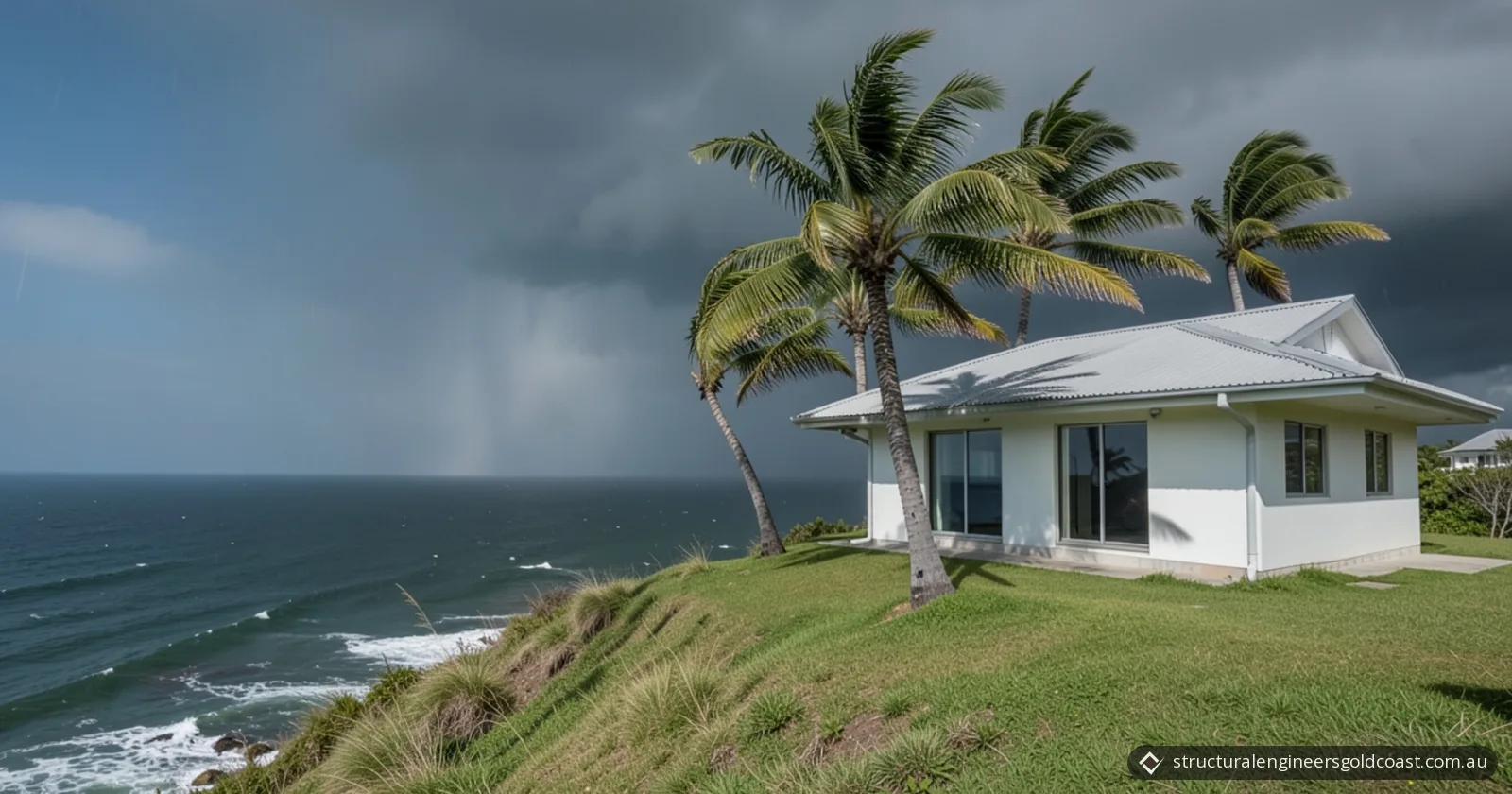
Within Region B, the terrain category, shielding and topography of a site can move a house's class anywhere from N2 to N6. The Fielders guide defines them:
- Terrain category is the roughness of the ground within 500 m of the site. TC1 is very exposed terrain and all water surfaces, such as the open ocean, rivers, canals and lakes. TC2 is open terrain such as farmland, TC2.5 is acreage or developing outer suburbs, and TC3 is suburban housing. Western Australia's building regulator advises using the lowest-numbered category within 500 m, so a site within 500 m of a river, lake or canal wider than 200 m will typically be TC1 (Building and Energy WA, IB 124).
- Shielding is the effect of surrounding buildings on the wind speed at the site. Full shielding needs at least two rows of houses all round and no open areas within 100 m. The row of houses facing open parkland, open water or airfields has no shielding.
- Topography is the effect of rising ground. Land flatter than 1 in 20, and the lower third of any hill, is T0. The top third of a slope of 1 in 3 or steeper, on a hill over 30 m high, is T5. Full shielding can only be used from T0 to T2.
Six examples from the Fielders table (other shielding and topography combinations give other classes):
| Terrain category | Shielding | Topography | Region B wind class |
|---|---|---|---|
| TC3 (suburban) | Full | T0 (flat) | N2 |
| TC3 (suburban) | None | T0 (flat) | N3 |
| TC2.5 (acreage) | None | T2 | N4 |
| TC1 (open water) | None | T0 (flat) | N4 |
| TC3 (suburban) | None | T5 (top of a steep hill) | N5 |
| TC2 (open terrain) | None | T5 (top of a steep hill) | N6 |
So a house in the first row facing the ocean or a wide waterway, or near the top of a steep hinterland ridge, can sit two or more classes above a sheltered suburban house in the same region.
What does the wind class change in a house?
The wind class sets the forces the roof, frame, windows and doors must resist, and above N3 it rules out several simplified building details. HIA explains that the uplift and racking forces from AS 4055 are used to work out the amount and location of wall and roof bracing, tie-downs and fixings (HIA: Wind loads for housing).
| Part of the house | What the wind class changes |
|---|---|
| Roof tie-down | Western Australia's building regulator notes that net design uplift at the top of walls can almost double from one class to the next for metal roofs, with an even greater increase possible for tiled roofs. |
| Timber framing | AS 1684.2 covers non-cyclonic classes N1 to N4, and AS 1684.4 covers N1 and N2 only (HIA: AS 1684.2). |
| Windows and glazed doors | AS 2047 window ratings for houses use design wind speeds from AS 4055 (QBCC). The Housing Provisions' window installation details apply only up to N3. |
| Masonry, metal and tile roofs, structural steel members | The Housing Provisions' simplified details apply only up to N3. Above that, the NCC points to standards such as AS 3700 for masonry, AS 1562.1 for metal roofing and AS 2050 for roof tiles. |
The N3 limits are set in clauses H1D5 to H1D8 of NCC 2022 Volume Two (NCC 2022 Volume Two, Part H1).
What are the wind rating rules in Queensland?
Queensland applies NCC 2022, which lets the wind actions on a house be worked out with AS/NZS 1170.2 or AS 4055, because the state has delayed the start of NCC 2025 until 1 May 2027 (Business Queensland).
- Site assessment. The Queensland Building and Construction Commission (QBCC) says that when ordering windows for a house, it is important to give the manufacturer a site wind speed assessment to AS 4055 from a professional engineer or other suitably qualified person (QBCC fact sheet).
- RPEQ work. Outside the scope of AS 4055, the QBCC calls for wind pressures to be determined by a Registered Professional Engineer of Queensland (RPEQ) under AS/NZS 1170.2. It notes that these calculations are a professional engineering service, which the Professional Engineers Act 2002 requires an RPEQ to carry out.
- Cyclonic-area rules. NCC 2022 calls up AS/NZS 4505 for garage doors in openings up to 3 m high (Housing Provisions 2.2.4) and Low-High-Low cyclic testing of metal roofs (clause H1D7) only in Regions C and D, which it calls cyclonic areas. Western Australia's state variation extends both to Region B, and in WA Region B gets C classes; Queensland has no such variation.
- Council. The City of Gold Coast's Program AIR is a five-year initiative whose objectives include advocating for more resilient building design standards in South East Queensland (Geoscience Australia).
When to call a structural engineer
Call a structural engineer when the house or site falls outside the simple cases that AS 4055 and the Housing Provisions cover:
- the house is over two storeys, wider than 16 m or higher than 8.5 m, so the wind pressures come from AS/NZS 1170.2, which is RPEQ work in Queensland;
- the site rates N4 or higher, where the simplified masonry, roofing, steel and window details stop;
- the block has no shielding, faces open water or parkland, or sits near the top of a steep slope;
- you plan to add a storey or re-roof, and want the tie-down and bracing checked against the site's class.
Our structural engineering design service covers new homes, additions and renovations, from footings to roof. For an existing house, a structural inspection is an on-site assessment of the foundations and frame, with a written recommendation on what to do next.
Frequently asked questions
Does adding a second storey change how the wind rating is worked out?
It can. Western Australia's building regulator notes that the AS 4055 size limits apply to the completed house, so adding a storey may take it outside AS 4055. AS/NZS 1170.2 should then be used for the design wind speed, and the result could be used to derive an N or C class for designing windows.
Will the first house in a new estate get a higher wind rating?
Not necessarily. Western Australia's building regulator explains that AS 4055 classes are based on the likely terrain and shielding five years from the design stage, so a house can be classed on a reasonable assumption of the houses built around it by then. Under AS/NZS 1170.2, only houses at least as big that are already built or under construction count as shielding.
What do W33 and W41 mean on building products?
They are a common alternative notation for the AS 4055 classes. Metroll's wind speed guide lists N1 as W28, N2 as W33, N3 as W41, N4 as W50, N5 as W60 and N6 as W70, with a C added for the cyclonic classes, so C1 is W41C.
Does the wind rating affect how weatherproof windows must be?
Yes. Windows are tested to AS 2047 for water penetration resistance, and the Australian Glass and Window Association's guide lists test pressures that rise with the window rating: from 150 Pa for a non-exposed N1 or N2 window to 600 Pa for an exposed N6 or C4 window.
Sources
- Fielders (BlueScope): TIG10 Wind classification design guide (August 2025)
- ABCB: NCC 2022 Housing Provisions, Part 2.2 Structural provisions
- ABCB: NCC 2022 Volume Two, Part H1 Structure
- Sexton et al., Preparing for the expected: tropical cyclones in South East Queensland (Australian Journal of Emergency Management, October 2023)
- Ginger (Cyclone Testing Station, JCU) and Holmes (JDH Consulting), Research and revisions in AS/NZS 1170.2-2021 (2022)
- QBCC: How to identify selection criteria for windows and glazed external doors (fact sheet, October 2022)
- Business Queensland: Delayed adoption of the National Construction Code 2025 in Queensland
- Geoscience Australia: Informing improved cyclone preparation on the Gold Coast (June 2024)
- HIA: Wind loads for housing (February 2025)
- HIA: Residential timber-framed construction, Part 2: Non-cyclonic areas (January 2022)
- Building and Energy (Western Australia): Industry Bulletin 124, Warning on inappropriate wind classifications
- Australian Glass and Window Association: A guide to window and door selection
- Metroll: Designing for wind speeds, a guide to wind classification (September 2020)