Inspections
In short: Building defects in Queensland are faulty or unsatisfactory building work. The Queensland Building and Construction Commission (QBCC) splits them into structural and non-structural defects. Notify your builder in writing, then lodge a QBCC complaint within 12 months of noticing a defect, or for non-structural defects within 12 months of completion. Home warranty claims close sooner: 3 months after noticing a structural defect, or 7 months after completion for others.
Key takeaways
- Structural defects adversely affect a building's structural performance, occupants' health or safety, or its functional use, or they let water into the building.
- A request for a QBCC direction to rectify must be made within 12 months of becoming aware of the defective work.
- The QBCC cannot direct rectification more than 6 years and 6 months after the work was completed, unless the tribunal extends the time.
- Home warranty claims close 3 months after you notice a structural defect, or 7 months after completion for non-structural defects.
- The QBCC's Standards and Tolerances Guide sets crack categories: category 3 or greater damage to walls is a defect.
Found cracking, leaks or movement in recent building work? Book a structural inspection or call 07 5638 5491.
What counts as a building defect in Queensland?
A building defect in Queensland is building work that is faulty or unsatisfactory. That is how the Queensland Building and Construction Commission Act 1991 (the QBCC Act) describes "defective" work in its dictionary, Schedule 2. The QBCC says this includes work that does not comply with the Building Act 1975, the Building Code of Australia or an applicable Australian Standard. It also includes a manufactured product installed in a way that does not follow the manufacturer's instructions.
Not every complaint about a build is a defect. The QBCC gives an example: a leaking roof is defective work, but roof tiles in the wrong colour are a contractual issue. The QBCC has limited power over contractual disputes.
How does the QBCC separate structural from non-structural defects?
The QBCC separates defects by their effect on the building, and the split decides how long you have to get help. The definitions come from the Queensland Building and Construction Board's Rectification of Building Work Policy, which the QBCC has regard to when it responds to defect complaints.
| Structural defective building work | Non-structural defective building work | |
|---|---|---|
| What makes it defective | It adversely affects the structural performance of a building, the health or safety of occupants or the functional use of a building, or it allows water penetration into a building | It does not meet a reasonable standard of construction or finish expected of a competent licensed contractor of the relevant class, or it has caused a settling-in period defect in a new building |
| QBCC examples | Leaking roof, leaking shower to internal walls, major cracking of walls | Chipped internal paintwork, sticking drawers, minor cracking of plasterboard |
| Excluded | Residential construction work causing subsidence, which the policy deals with separately | Structural defects and work causing subsidence |
The examples come from the QBCC's Rectification of Building Work Regulatory Guide. The policy defines subsidence as foundation movement that causes footing or slab deflection or other damage beyond that allowed for in applicable Australian Standards, including AS 2870 and AS 3600.
The Queensland Home Warranty Scheme uses its own definition of a structural defect, in Schedule 6 of the QBCC Regulation 2018. For a home, it covers defects that cause or contribute to footing or slab movement so the home no longer complies with the Building Act 1975's building assessment provisions, breaches of the structural performance requirements in Building Code of Australia Part B1 or Part 2.1, and defects that make the home uninhabitable or not reasonably accessible, adversely affect the health or safety of occupants, or let water in.
What are the time limits to report building defects?
For a QBCC complaint, the time limit is 12 months: a request for a QBCC direction to rectify must be made within 12 months of becoming aware of the defective work, under section 71J of the QBCC Act. Home warranty limits are shorter, and the QBCC says these insurance timeframes are specified by legislation and strictly applied.
| Limit | Structural defects | Non-structural defects | Where it comes from |
|---|---|---|---|
| Lodge a QBCC complaint | As soon as possible, within 12 months of noticing the defect | As soon as possible, no later than 12 months from completion | QBCC Act s 71J; QBCC "Help with defective work" |
| Latest a QBCC direction to rectify can be given | 6 years and 6 months after the work was completed, unless the tribunal extends the time | The QBCC will consider a direction within 12 months of completion | QBCC Act s 72A(4); Rectification of Building Work Policy |
| You must notice the defect (or reasonably should have) within this period for home warranty cover | Within 6 years and 6 months after the cover commencement day (policies since 28 Oct 2016; later if work took longer than 6 months to reach substantial completion) | Within 6 months after the work is substantially complete | QBCC Regulation 2018, Sch 6 s 16 |
| Lodge a home warranty claim | Within 3 months of becoming aware of the defect | Within 7 months after the work is substantially complete | QBCC Regulation 2018, Sch 6 s 16 |
| Start court proceedings for breach of statutory warranty | 6 years from completion (6 months more if the breach becomes apparent in the last 6 months) | 1 year from completion (6 months more if the breach becomes apparent in the last 6 months) | QBCC Act Sch 1B s 29 |
How do you lodge a defective work complaint with the QBCC?
You lodge a defective work complaint online through the QBCC Portal, after giving the contractor written notice and a chance to fix the work. The QBCC's lodgement steps are:
- Check your contract. It sets out how disputes are handled and any warranty period for minor defects.
- Notify the contractor in writing. List each defective or unfinished item and give a timeframe to fix it. The QBCC uses 14 days as an example.
- Check the contractor's licence on the QBCC Licensee Register.
- Allow reasonable access. That means an agreed time in normal working hours, full consecutive days if needed, with at least 48 hours' notice from the contractor. Refusing access stops the QBCC directing rectification and may affect a home warranty claim.
- Lodge the form. In the QBCC Portal, complete the Residential and commercial construction complaint form and upload your documents: the notice and the contract, plus the Contract of Sale and any pre-purchase inspection report if the work was done before you bought.
The QBCC then emails a case number. If it can't help, it sends a letter that allows you to apply to the Queensland Civil and Administrative Tribunal (QCAT).
The QBCC's eligibility rules say most building work must have a contract value over $3,300, including labour, materials and GST. Electrical work, defects not caused by the contractor (for example, natural disasters) and work where the contractor can't be identified are not eligible.
Building defect rules for Gold Coast homeowners
Gold Coast homeowners use the same QBCC complaint process and time limits as the rest of Queensland. The QBCC has a Gold Coast customer service centre at Robina for over-the-counter service, and its phone line is 139 333. Online lodgement is quicker: the QBCC says manual lodgements take longer, especially when documents are missing.
What should an engineer's defect report contain?
An engineer's defect report should describe each item, measure it, compare it with the standard or tolerance that applies, and say what rectification is needed. The QBCC must be reasonably satisfied, on the balance of probabilities, that work is defective. Its regulatory guide says it will try to, but does not need to, identify the exact cause before issuing a direction.
A useful report for a Queensland defect dispute covers these points:
- Each item, located and photographed. Judge finish items from the guide's normal viewing position: 1.5 m or more (600 mm for appliances and fixtures, 3 m for glass) in non-critical light.
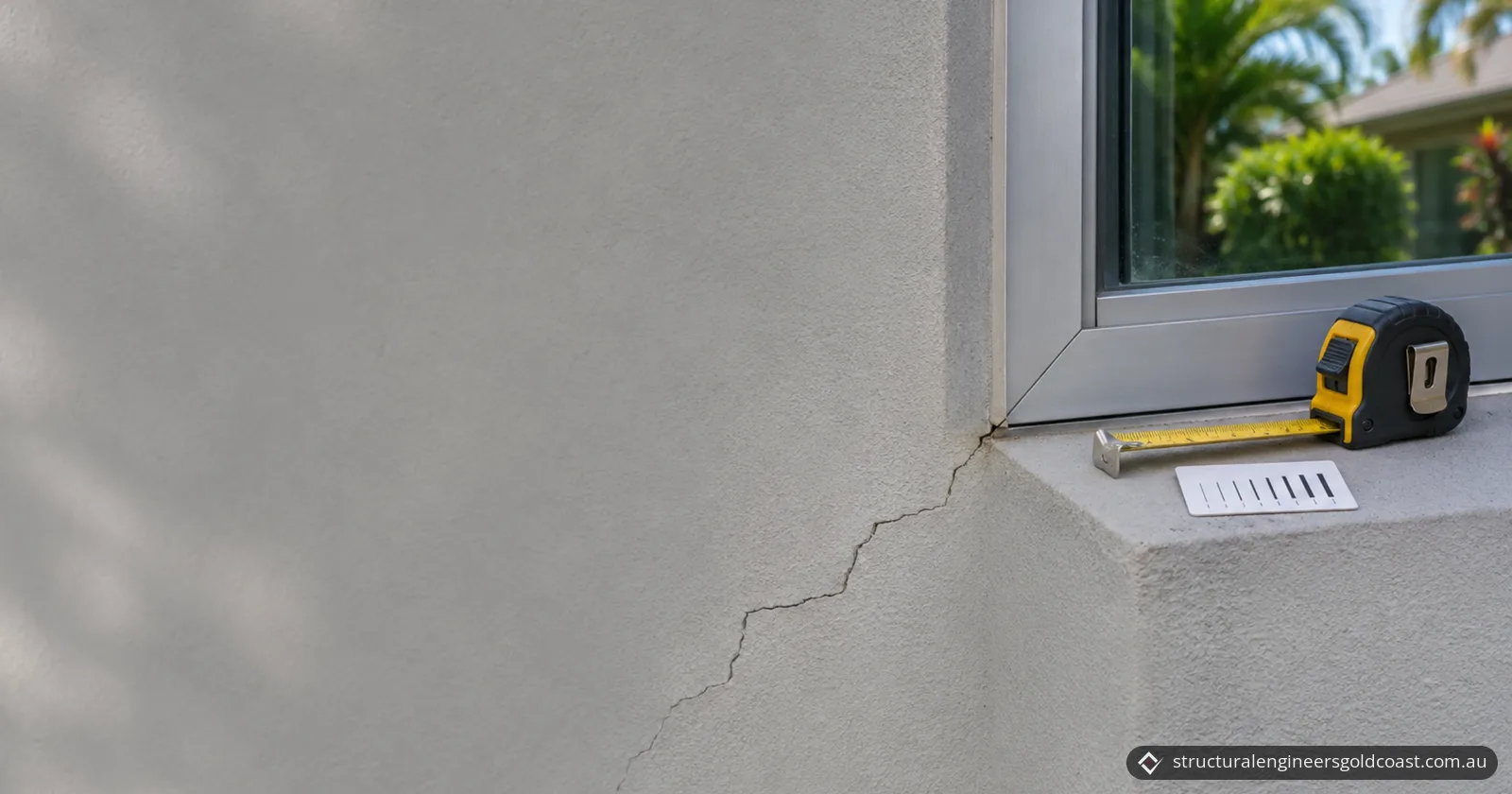
- Measurements against the QBCC guide. For masonry walls, Table 4.2 of the Standards and Tolerances Guide, taken from AS 2870, grades damage by crack width: category 1 is under 1 mm, category 2 under 5 mm, category 3 is 5 to 15 mm (or a number of cracks 3 mm or more in one group), and category 4 is 15 to 25 mm (also depends on the number of cracks). Limits may be increased by 50% for cracks in plasterboard or similar clad-framed partitions. Category 0, 1 and 2 cracks to walls are not defects, but category 2 damage is a defect if it is identified within 12 months of completion.
- Whether each item is structural or non-structural, with the reason, because that sets the time limits.
- The likely cause, including whether maintenance, landscaping or later work by others played a part.
- The rectification or further investigation needed. The guide says category 3 or greater wall damage needs investigation, stabilisation, monitoring and rectification.
For concrete floors, Table 3.10 of the guide treats category 3 and 4 slab cracks as defects.
When to call a structural engineer
Call a structural engineer when a possible defect could be structural, or when you need evidence before a time limit runs out. Book an inspection if:
- wall cracks look 5 mm or wider, or doors and windows have started to stick;
- a slab has cracked or changed level;
- water is getting into the house through the roof, walls or a shower;
- the builder disputes whether an item is structural;
- you are close to a 3-month home warranty or 12-month complaint deadline.
Under the Professional Engineers Act 2002, registration with practising status is needed to carry out a professional engineering service in or for Queensland.
Start with a structural inspection. Our reports and certifications service covers defect and remedial reporting. To get a quote, send photos of each item, the completion date and your suburb.
Example from our projects
In a balcony post inspection in Tugun, a cracked hardwood post was traced to a corroded steel base plate, with no evidence of foundation settlement observed. In a termite-damaged wall assessment in Varsity Lakes, the report specified a new bottom plate and stud splices before repairs began.
Frequently asked questions
Does the defects period in my building contract limit what the QBCC can do?
Not on its own. Section 72(3) of the QBCC Act says that, when deciding whether to direct rectification, the QBCC is not limited to the terms of the contract, including any warranties in it.
Who lodges a defect complaint in a unit or townhouse complex?
Each unit owner lodges the complaint for defects in their own property, and the body corporate representative lodges it for common property. For example, the body corporate lodges for a roof leak, and owners lodge for ceiling damage inside their units.
What if the work doesn't match the plans but still complies with the building code?
Under the home warranty terms in the QBCC Regulation 2018, if work departs from the plans but complies with the Building Act 1975, the Building Code of Australia and the Queensland Development Code, and its use is not significantly affected, the claim is for the loss in value of the work, not the cost of rectifying it.
Will the QBCC make a dangerous defect safe?
No. The QBCC says it does not provide a "make safe" service. If there are immediate safety concerns, it recommends restricting access to unsafe areas.
Sources
- QBCC: What is defective work
- QBCC: Help with defective work
- QBCC: Lodge a defective work complaint
- QBCC: Home warranty for defective work claims
- QBCC: Rectification of Building Work Regulatory Guide (September 2020)
- Queensland Building and Construction Board: Rectification of Building Work Policy (effective 10 October 2014)
- QBCC: Standards and Tolerances Guide (December 2023)
- Queensland legislation: Queensland Building and Construction Commission Act 1991
- Queensland legislation: Queensland Building and Construction Commission Regulation 2018
- QBCC: Contact us (customer service centres)
- Australian Business Licence and Information Service: Registration as a professional engineer, Queensland